What Claude can already do for client records
Quite a lot, for one person with a handful of clients. Memory, on every plan, saves what you discuss. Projects keep client files and instructions together. On paid plans, chat search finds old conversations and scheduled tasks run a prompt hourly, daily or weekly. We checked each against Anthropic’s help pages on October 3, 2026.
Of US small businesses that use AI, 31% say they use it to manage customer relationships (US Chamber of Commerce, October 2026).
| Claude feature | What it does for client notes | Plans | Limit for CRM use |
|---|---|---|---|
| Memory | Saves what you discuss as topics you can read, edit and delete | Every plan. On by default on Free, Pro and Max; on Team and Enterprise, members turn it on if owners allow it | Separate in each project. Edits aren’t logged |
| Projects | Keeps client files (project knowledge), instructions and chats together | Every plan; Free has up to 5 projects. Team and Enterprise can share a project with view or edit rights | You add and update the files yourself |
| Chat search | Finds what you said in past chats | Pro, Max, Team and Enterprise | Finds chats, not a client list |
| Scheduled tasks | Runs a prompt hourly, daily, weekly or on weekdays, in the cloud, with your connectors | Pro, Max, Team and Enterprise | Runs on a clock. No triggers from events |
| Connectors | Let Claude read and update other tools | Every plan. Free allows one custom connector. On Team and Enterprise, an Owner switches them on | Only as useful as the tool on the other end |
Each feature name links to its Claude Help Center article. Scheduled tasks are documented under Cowork, which Anthropic is merging with chat, starting with Pro and Max.
For one person with 5 or 10 clients, using Claude as a CRM can work, and a “Clients” Project plus memory may be enough.
Running your clients from Claude alone
If that’s you, set it up like this:
- Make one “Clients” Project with a file per client: who they are, what you agreed, the next step and its date, and what they owe.
- Add a project instruction such as “When I tell you about a client, tell me what to change in their file.”
- After each call, update the file. Each morning, ask Claude who’s due this week.
It works while you keep the files current. Skip the updates during a busy week, and Claude’s answer to “who’s due this week?” is only as good as the last file you updated.
Where Claude on its own stops being a CRM
Claude as a CRM falls short on the boring parts: one record per customer, follow-up dates that are tracked for you, one client list the whole team works from, and a history you can undo. Claude’s memory is saved as topics, kept separately in each project and not logged when you edit it.
People who’ve tried it say the same thing: a chatbot is a tool, not a system of record.
There’s no customer record, only notes
What you tell Claude ends up spread across memory topics, project files and past chats. Nothing checks “Sam” against a client list to find the right Sam. Mention a client in two projects, and Claude keeps two separate memories of them.
Scheduled tasks run on a clock, not on your follow-ups
On a paid plan, a scheduled task can run a prompt every weekday at 8am. But it needs something to check, and Claude keeps no list of due dates for it to read unless you keep one yourself. Claude Free has no scheduled tasks.
Memory is personal, and stays in one project
Each project has its own memory, and on Team and Enterprise, owners can’t view members’ memories. A shared Project gives everyone the same files, but someone still has to keep them current. Cursor and ChatGPT can’t read Claude’s memory while you work; moving it to another AI app is an export Anthropic calls experimental. So a new project, a new app or a new teammate means explaining your clients all over again.
You can edit memory, but you can’t see what changed
You can open any memory topic and change or delete it. Anthropic says individual memory edits aren’t logged, though, so there’s no list of what changed, no label for who changed it and no undo.
Money, quotes and invoices live somewhere else
Claude can draft an invoice in a chat. Invoice numbers that never repeat, tax worked out per line and a running total of who owes you what need a record that does the arithmetic the same way every time. With Zyflow connected, Claude does the talking and Zyflow does the math.
How to give Claude a CRM it can update
Add the CRM to Claude as a custom connector. Every Claude plan supports them, and Claude Free allows one. With Zyflow it takes about two minutes: paste one link, sign in, approve one workspace and start talking. Claude keeps its memory and Projects; the customer record lives in Zyflow.
-
Create a free Zyflow account.
-
In Claude, add a custom connector and paste your Zyflow link.
-
Sign in and approve one workspace. It works like “Sign in with Google”: you never paste a password into Claude.
-
Tell Claude what happened on your last client call.
On Claude Team or Enterprise, a Claude Owner or Primary Owner sets up connectors for the organization first. Your Claude plan’s own usage limits still apply.
The setup guide has the click-by-click steps, screenshots and troubleshooting. For the plan table and what Claude can and can’t touch, see the Claude CRM page.
Free plan. No card.
What Claude can do once it’s connected: prompts and results
Once connected, Claude looks up, logs and updates customers through Zyflow while you talk, and Zyflow keeps the record. Each thing Claude does is one labeled change with an Undo.1
Here’s a working day once your clients are in Zyflow.
Morning:
- What’s on my plate today?
What happens: Claude gives you Zyflow’s ranked morning list: overdue follow-ups, payments to chase, what’s due today, birthdays, stuck deals and customers gone quiet. Today shows the same list; the 8am email carries the follow-ups, payments and birthdays.
Reminders show on Today, in your AI and in the 8am email. Nothing is pushed to your phone.
Before a call:
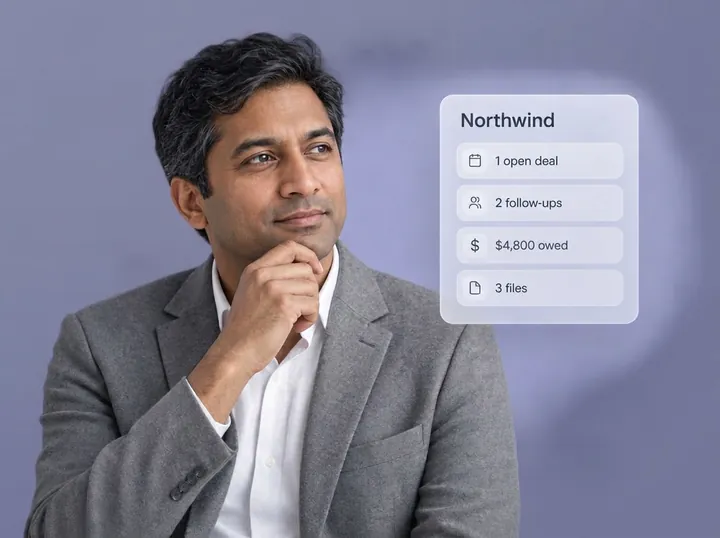
- What do we know about Northwind?
What happens: Claude pulls one brief from Zyflow: facts, open deals, follow-ups, money owed (marked OVERDUE when late), files and the next step, with an “Open in Zyflow” link.
After the call:
- Had a call with Maya at Northwind. She wants the revised quote by Friday.
What happens: Claude logs the call and sets the follow-up on the customer you already have, in one change. Zyflow works out which Friday in your time zone, and Claude reads it back: Fri, 9 Oct.
A name that fits two people:
- Log a call with Sam about the workshop dates.
What happens: Zyflow finds two Sams and sends Claude both, with what tells them apart. Claude asks: “Sam Ortiz at Halden or Sam Lee at Fieldhouse?” You answer, and the call lands on the right Sam.
Money:
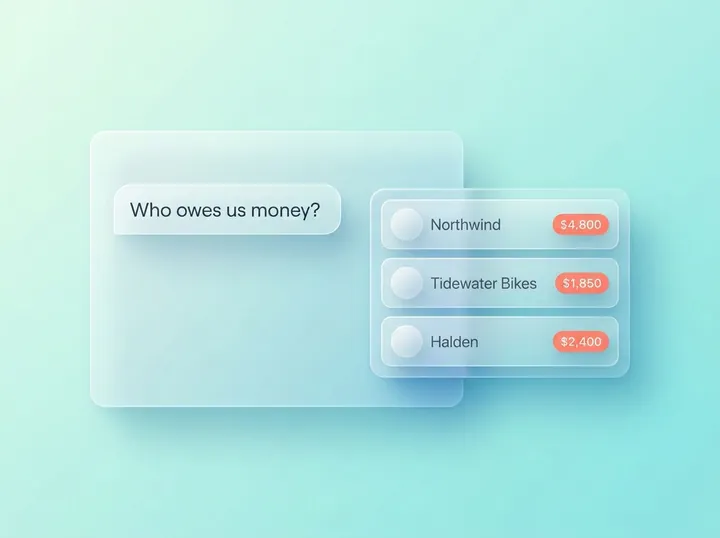
- Northwind owes $4,800 and will pay by the 15th.
What happens: Zyflow records the balance, the promise date and one reminder to chase it. The reminder closes itself once they’re paid up.
Zyflow records payments; it doesn’t collect them. There are no card payment links.
A slip:
- Undo what you just did.
What happens: Zyflow puts back everything from Claude’s last action in one step. An undo can be undone too.1
Every write above goes through the same four guardrails: Ask. Match. Label. Undo. Each change is labeled “Added by Claude via MCP”, and History lists them all.
Keep Claude’s memory and Projects for what they do well
Use Projects for proposals, templates and your tone of voice. Let Claude’s memory hold how you like to work. Keep customers in Zyflow, where every app you connect reads the same facts: tell Claude on Monday that Maya prefers calls after 2pm, and Cursor has it on Tuesday.
Zyflow doesn’t decide what to remember. You or your AI do.
Zyflow doesn’t read your inbox, calendar, calls or WhatsApp. Tell your AI, or paste the thread, and your AI files it after showing you what it found.
Using Claude Code? One command
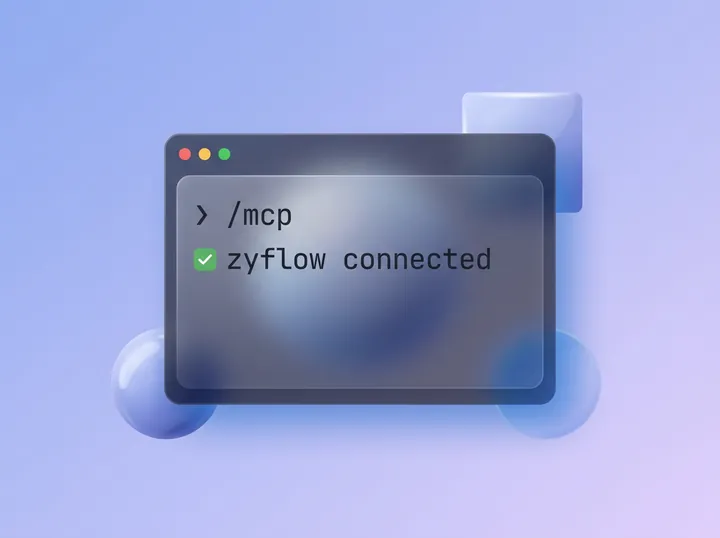
Claude Code connects with one command; then run /mcp to sign in and approve a workspace. Changes from the terminal are labeled with Claude Code’s name, and the same customers show up in Claude on the web.
Command (copy this):
claude mcp add --transport http zyflow https://app.zyflowcrm.com/mcpThen run /mcp inside Claude Code to sign in and approve a workspace.
Read the Claude Code setup guide
Tempted to build your own instead? Plenty of people start there. The Claude Code CRM guide compares building with connecting, part by part: matching, duplicates, undo, history and sign-in.
The same Zyflow link works in any MCP app. The CRM MCP server page lists every tool Claude can call.
Claude alone vs Claude with a connected CRM
Claude alone is good at recall and drafting. With Zyflow connected, you add what memory doesn’t have: one record per customer, dated follow-ups, money owed, numbered invoices, one list for the team and an undo.
| Job | Claude on its own | Claude with Zyflow |
|---|---|---|
| Log a call | Saved to memory, or left in the chat | Logged on the customer you already have, labeled “Added by Claude via MCP” |
| Recall a client | Memory, one project at a time, plus chat search on paid plans | One brief: facts, deals, follow-ups, money owed and files |
| Follow-up due Friday | No list of due dates | A dated follow-up, read back as “Fri, 9 Oct” and shown on Today |
| Tomorrow morning | Only what a paid-plan scheduled task finds | Today, “What’s on my plate today?” and the 8am email |
| Money owed | Whatever you wrote down | A balance, a promise date and a reminder that closes itself |
| Invoices and quotes | Claude drafts; you number and total | A numbered PDF with tax worked out per line, filed on the customer |
| Team | Memory is personal; Projects can be shared on Team and Enterprise | Every member, and each member’s AI, on one record |
| A wrong write | Edit or delete the memory; edits aren’t logged | Labeled, and undone in one click1 |
| Switch AI apps | Memory stays in Claude; export to other apps is experimental | The same records in any MCP app; ChatGPT writes on Business plans2 |
| Leave | Memory comes with Claude’s data export | 6 CSVs, or one JSON with your history3 |
Claude features checked Oct 3, 2026 against Anthropic’s help pages. Spot an error? Tell us.
Zyflow works out totals, tax and numbering; unit prices come from what you or your AI enter. Every member, and every member’s AI, can see and edit every customer; there are no per-person permissions yet.
Questions about using Claude as a CRM
Can I use Claude as a CRM for free?
Yes, with limits. Claude Free has memory and up to 5 projects, and it allows one custom connector, which is enough for Zyflow. Chat search and scheduled tasks need a paid Claude plan. Zyflow Free costs $0 for one person, with no card and no time limit.
Isn’t an LLM the wrong place to keep customer data?
Agreed, and that’s the design. Claude is how you talk to your records; Zyflow is where they live, as structured customers, deals, follow-ups and facts in your own workspace, kept apart from every other workspace. You can export your records, documents and history any time.3
What if Claude logs something on the wrong person, or makes a duplicate?
Claude asks before it guesses, and you can undo what still goes wrong. When a name could mean two people, Zyflow sends Claude the candidates and Claude asks which one you mean. Saves land on the customer you already have, and similar new names are flagged, never merged automatically. If something lands wrong anyway, it’s labeled “Added by Claude via MCP”, and one click undoes it.1
Can I keep using Claude’s memory and Projects?
Yes, and you should. Keep Projects for proposals and tone, memory for how you like to work, and customers in Zyflow. Zyflow doesn’t read your chats or Claude’s memory; it receives only what Claude sends when it looks something up or saves a change.
Can my team see the same clients?
Yes, in Zyflow. Everyone in your workspace, and each person’s Claude, works on the same customers, with each change labeled by person and app, such as “Claude for Dana”. Claude’s own memory stays personal: on Team and Enterprise, owners can’t view members’ memories (checked Oct 3, 2026). Zyflow has no per-person permissions yet. Zyflow’s Free plan is for one person; Solo covers up to 3 people and Zyflow’s Team plan up to 10.
Does it read my email or calendar?
No. Zyflow doesn’t sync email, calendars, calls or WhatsApp. Tell Claude what happened in a sentence, or paste the thread, and Claude files it on the right customer. If Claude has Gmail connected through its own connector, it can read a thread there and log it to Zyflow.
Will my client data go to Anthropic?
Yes, whatever Claude reads from Zyflow passes through Claude, so Anthropic’s terms and your Claude data settings cover it. Zyflow receives only what Claude sends when it looks something up or saves a change, not the rest of your chat. You choose the one workspace Claude can reach, and you can disconnect it any time. Zyflow runs no AI model and doesn’t train one on your data. It’s a fair worry: in a vendor survey, half of small-business owners named data security as their biggest hesitation about AI (Anthropic, May 2026).
Does it cost extra on top of my Claude plan?
Not for AI. Zyflow runs no AI of its own and sells no AI credits. Free for one person. Solo covers up to 3 people for $12 a month ($10 billed yearly), Team up to 10 for $30 ($25 billed yearly) and Pro up to 30 for $90 ($75 billed yearly). One price for the whole team, and your AI’s calls are never billed. Prices in US$. Claude’s own usage limits still apply.
Doesn’t HubSpot already connect to Claude?
Yes. Connecting is table stakes now: HubSpot, Pipedrive, Attio, Close and Zoho all list connectors in Claude’s directory. HubSpot Free is a fair deal for two people and 1,000 contacts, and its MCP server has been open to every HubSpot account since April 13, 2026. Past Free, HubSpot Starter is from $7 a seat a month billed yearly for new customers, or $20 billed monthly (checked Oct 3, 2026). Zyflow’s case is the combination: Claude’s writes are labeled and can be undone,1 invoices, quotes and files sit in the same record, and one price covers the whole team.
Not a fit if...
Zyflow isn’t a fit yet if you need email or calendar sync, card payment collection, SSO or two-factor sign-in, a home for regulated data such as patient records, or more than 30 people.
And if you have a handful of clients and keep their files current, Claude’s memory and a “Clients” Project may be all you need.